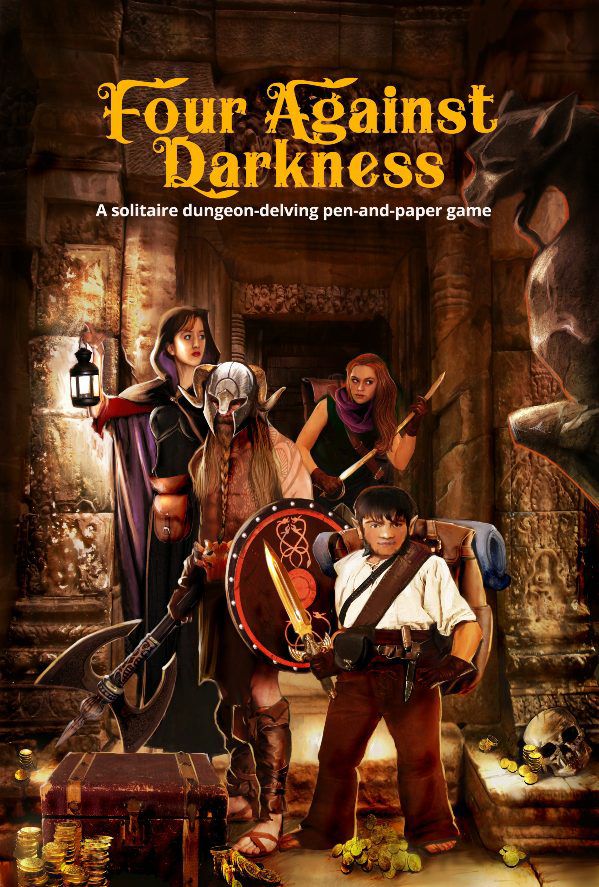
Four Against Darkness
(Link)
Four Against Darkness
- Four Against Darkness: A solitaire dungeon-delving pen-and-paper game
- 4AD
I picked this up because I'd heard good things about it on the Lone Wolf discord server and elsewhere, and the core book was just $8. So far, I'm enjoying it.
What is it?
Four Against Darkness is a dungeon-crawling game. It insists that it is emphatically "NOT a roleplaying game"–which I think is debatable. Sure, you can play it purely mechanically, in which case it's similar to a board game, something like Donsol.
But you create these characters, give them names, then make decisions for them about what risks they'll take, how they'll divide up loot, whether they'll go through the trouble of carrying their friends' corpses out of the dungeon and fork over for a resurrection attempt. You can play it in multiplayer, if you like, with another person controlling some of the characters, choosing your path by consensus. And while the base game doesn't have a story, there are plenty of (official!) supplements that do.
So, is it roleplaying? It's as much roleplaying as a journaling game like Thousand Year Old Vampire or Alone Among the Stars, I think, and that's close enough for me. Roleplaying is what you make of it–especially solo roleplaying.
How do you play?
You create a party of four characters, pick out some starting equipment, then enter a dungeon. Roll to determine the shape of the dungeon–there are 36 room shapes that you fit together as you go to create the map, one room at a time. When you create a room, you roll to determine its contents, which could include treasure, traps, monsters, or more. When you encounter monsters, you fight: choose your actions and roll to see if you succeed. Eventually, you fight the final boss, and make your way back out of the dungeon with the spoils of victory, and possibly with one or two of your comrades' corpses in tow.
There's no roleplaying required–you needn't come up with a story to carry all this out, so those who prefer less writing in their solo games might find that appealing. On the other hand, if you do want some story, the random nature of the encounters makes it tough to create a story more complex than "we went into a dungeon because there was treasure there", at least at the small scale. You could fit a story to the larger campaign the dungeon trips are part of, though, with a little work.
What do you need?
Graph paper, pencils, erasers (so much erasing…), and some d6's are all you need, besides the book. I'm using this printable play sheet, which is much nicer than what's included with the rule book. The inventory space can get a bit crowded, but it's very handy to have everything on one sheet, and I track encounters on the back of the page.
What else should I know?
The rule book is, by general consensus, rather confusing and poorly arranged. You'll have to flip back and forth between sections dozens of pages apart to understand how to run encounters, and overall the rules aren't laid out in any logical order. It starts with character creation and how to begin rolling up a dungeon, but you can't just start playing as you go along. You'll have to read the whole book before you begin.
However, a new edition of the rule book is being developed, which is intended to rectify these problems, and add some important content from a couple of supplements to the base game. It is, supposedly, to be released during August 2025. It's been in development, with various missed release dates, for several years, but as of [2025-08-03 Sun 20:48], there are sample pages from the new edition on the author's Patreon, and it seems likely a release really is imminent.
While I'm waiting for that, though, there are still questions to be answered, so I'm making a reference section to keep a record of my confusion.
Where do we go from here?
There are numerous supplements that expand the game substantially. Some, like Caves of the Kobold Slave-Masters, provide adventures with a story that you can play through. Others add new mechanics. Still others are simply books of tables that add new items or monsters. You can mix and match these to get whatever experience you desire, or roll your own–the system is simple enough that creating compatible content shouldn't be hard.
Frequently Asked Questions and Notes
Or not so frequent. Questions I had, anyway.
Starting a new game
- You must buy a lantern to take with you–no character starts with one. Fortunately, they cost 4 gp, so you're guaranteed to have enough gold.
Encounters
- If you have no weapon (for example, if invisible gremlins graced you with their presence), roll at -2 for attacks. (Sfiligoi, 2016, p. 52)
- When you've killed half the monsters in an encounter, or reduced a boss or weird monster to half its hit points, do a morale check. (Sfiligoi, 2016, p. 22)
- 1-3: The monsters flee.
- 4-6: The monsters fight to the death.
- When rolling for defense, you must exceed the enemy's level with your modified roll in order to succeed. Matching the enemy's level is a failure (Sfiligoi, 2016, p. 53). The "Defense procedure" on the Quick Reference Sheet (Sfiligoi, 2016, p. 84) is wrong!
Do you roll once per character for defense, or once per attacking monster?
Once per attacking monster. If there are twelve monsters attacking your four characters, then each character will roll three times to defend against them. (Sfiligoi, 2025)
How many attacks does a Small Dragon get when it is the final boss?
There is no 'official' answer that I can find. Suggestion: if it breathes fire, nothing changes. If it does melee attacks, it does 3 instead of 2.
What penalties are there for wearing heavy armor?
Levelling Up
Searching
Lockpicking
To succeed at lockpicking, the rules say you must "beat" the lock's level. What does that mean?
Like attacks, your roll must meet or exceed the lock's level to pick a lock (Sfiligoi, 2020).
Caves of the Kobold Slave-Masters
Chapter 1
- You may search rooms only when instructed.
- Do not roll for encounters when entering a new room. Just follow the instructions in the room.
- When entering a room you have already cleared, roll for wandering monsters. On 1, roll d6. On 1-3, roll on the Kobold Caves vermin table, p. 20. On 4-6 roll onthe demonic minion table, p. 18.
- If you skipped #15 on the way in, then its event will still be active if you choose to take it on the way out. It will be deactivated if you already passed through it on the way in. Otherwise, you can take #14 on the way out, in which case you should roll for its event as usual (Sfiligoi & Vallée, 2018).
Chapter 2
- When encountering a trap, a random character will be teleported to the demon (if they fail to save). If a rogue is in the front of the marching order (position 1 or 2), then you may attempt to disarm the trap (Truesdell & Sfiligoi, 2020).
Bibliography
Sfiligoi, A. (2016).
Four Against Darkness: A solitaire dungeon-delving pen-and-paper game (Revised rules, version 4.0). Ganesha Games.
Sfiligoi, A. (2020, June 7).
What does “beat the level” mean in lock picking? [Online post]. Four against Darkness Adventurer’s Guild | Facebook.
https://www.facebook.com/groups/350474872132324/?multi_permalinks=868430990336707&hoisted_section_header_type=recently_seenSfiligoi, A. (2025, July 17).
Do you roll defense per enemy attacking [Online post]. Four against Darkness Adventurer’s Guild | Facebook.
https://www.facebook.com/groups/350474872132324/posts/2127723891074071/?comment_id=2127725201073940&reply_comment_id=2127868181059642Sfiligoi, A., & Vallée, E. (2018, May 2).
Hey guys, i have a question about the first campaign of Caves of the Kobold Slave-Master. [Online post]. Four against Darkness Adventurer’s Guild | Facebook.
https://www.facebook.com/groups/350474872132324/search/?q=caves%20of%20the%20kobold%20slave-masters%20trapsTruesdell, C., & Sfiligoi, A. (2020, March 26).
Question About Traps in Chapter 2 [Online post]. RPGGeek | Four against Darkness: Caves of the Kobold Slave-Masters.
https://rpggeek.com/thread/2391909/article/34376859#34376859
Blurb
Four Against Darkness is a solitaire dungeon-delving game.
No miniatures are needed. All you need is the book, a pencil, two six sided dice, and grid paper.
You choose four character types from the classic classes (warrior, wizard, rogue, halfling, dwarf, barbarian, cleric, elf), equip them, and start adventuring in dungeons created by dice rolls and by your choices. When you enter a room, you generate its content on a series of random tables. You will meet monsters, fight them, hopefully defeat them (or decide that discretion is the better part of valor!), you'll manage your resources (healing, spells, life points, equipment), grab treasure, dodge traps, find clues, and even accept quests from the monsters you meet. Your characters can level up and become better at what they do, but it will not be easy.
What the game is not:
It is NOT a miniature game. You may use miniatures to remember your characters' marching order if you wish, but that's it.
It is NOT a roleplaying game. You may run it as a simple cooperative, GM-less game if you want.
It is not a game-book or a choose-your-own-adventure book. There is no prose to read or numbered sections to go to, even if we could do something like that in a supplement.
The PDF is 90 pages with plenty of black and white illustrations, plus a color cover and a flowchart. The download also includes mini-booklets for those who want to print the charts and other essential info in pocket-size. The main pdf is indexed so you can click on a rule in the table of contents and the link will lead you to the rule.